Plate Number Price in Nigeria 2026: JTB Fees and Real State Costs
Understand the true cost of vehicle number plates in Nigeria for 2026, beyond just JTB fees. Explore state-specific charges and official rates.
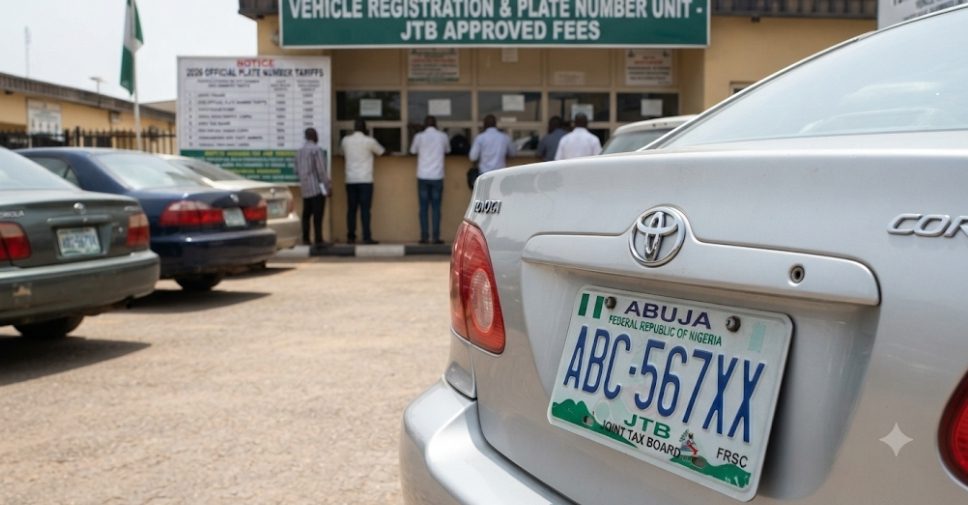
On 8 June 2025, the Joint Tax Board (JTB) implemented a new nationwide number plate and driver’s licence pricing structure that remains in force throughout 2026. These JTB figures are the ground truth for plate fees in every Nigerian state, from Lagos and Abuja to Kwara, Rivers and Kano.
The JTB schedule is clear and uniform:
| Plate category | JTB fee (₦) |
|---|---|
| Standard private vehicle plate | 30,000 |
| Standard commercial vehicle plate | 30,000 |
| Articulated vehicle plate | 90,000 |
| Dealer vehicle plate | 100,000 |
| Out-of-series plate | 150,000 |
| Fancy vehicle plate (private) | 400,000 |
| Government standard vehicle plate | 80,000 |
| Government fancy vehicle plate | 120,000 |
| Motorcycle plate (standard) | 12,000 |
| Fancy motorcycle plate | 50,000 |
| Government standard motorcycle plate | 20,000 |
| Government fancy motorcycle plate | 50,000 |
These figures were widely reported by Nigerian outlets and confirmed by FRSC and state revenue agencies as the new official plate‐only rates. For example, Radio Nigeria Lagos highlighted that standard plates jumped to ₦30,000 and fancy private plates doubled from ₦200,000 to ₦400,000, while motorcycle plates rose from ₦5,000 to ₦12,000.
However, this table is only half of the picture. When a car owner searches “plate number price in Nigeria 2026”, what they really care about is the total registration cost in their state, not just the JTB plate component—and that is where most online content stays vague or quietly omits the state layer.
2. Why JTB Fee ≠ Full State Cost
The JTB fee is a national baseline for the physical number plate and its category, but it is not the full registration bill a motorist pays at a licensing office. Every state adds its own charges on top of the JTB plate fee:
- Vehicle licence fee (usually for 1, 3 or 5 years).
- Registration/processing and administrative charges.
- Roadworthiness or inspection fees where applicable.
- Hackney permit or commercial operation fees for commercial vehicles and motorcycles.
For example, Kwara State Internal Revenue Service (KWIRS) publishes a full vehicle registration rates table where total packages for private vehicles range from ₦45,500 to ₦47,477.50—already well above the ₦30,000 plate fee. In these totals, the extra ₦15,500–17,477.50 covers licence duration, admin charges and engine‑capacity‑related differences.
This split between JTB base and state add‑ons explains why answers to “how much is plate number registration in Nigeria” differ so much from state to state and from one article to another:
- A writer quoting only JTB fees will say “standard plate is ₦30,000”.
- A Lagos or Kwara motorist who has just registered a car knows they paid significantly more, once licence and other charges were added.
- Some states publish their full price breakdowns (Kwirs, earlier Lagos tables); others do not, which makes clear, up‑to‑date state estimates hard without direct MVLA data.
3. State‑by‑State Breakdown (2026)
This section walks through key states, starting with Lagos and FCT/Abuja, then Kwara as a fully documented example, and other major states where only the JTB base is confirmed. It keeps the arithmetic transparent: JTB base + state add‑ons = realistic total, or state totals not confirmed where data is missing.
3.1 Lagos – MVAA and faded plate discount window
Lagos is one of the highest‑interest states for queries like “how much is Lagos plate number 2026”, but its most detailed published number plate price list dates from 2021 before the 2025 JTB increase. That earlier Lagos table showed:
- Blue (private) plates at ₦37,825.
- Red (commercial) plates at ₦41,300.
- Fancy plates at ₦210,175.
- Out‑of‑series plates at ₦60,175, and articulated at ₦57,675.
Those figures combined the old JTB plate fee with Lagos vehicle licence, registration and admin charges. After June 2025, Lagos adopted the new JTB structure—₦30,000 for standard plates, ₦400,000 for fancy, and so on—in line with national directives.
In 2026, Lagos made one specific, documented adjustment: a discount window for replacing faded number plates. The state reduced the cost of replacing faded plates to ₦20,000 for a limited period, down from a higher previous charge. The Nation reported that this concession applied to motorists whose plates had become unreadable, as part of an enforcement and compliance push.
Putting this together:
- Standard Lagos plate (new registration, 2026):
- JTB plate component: ₦30,000.
- State add‑ons: licence, registration, admin and possible inspection – not publicly re‑stated after the 2025 hike.
- Total: higher than ₦30,000, but precise 2025–2026 totals are not confirmed in fresh official tables.
- Faded plate replacement in Lagos (2026 discount window):
- JTB base for a standard plate is still ₦30,000.
- Lagos discount reduces the effective payable for replacement to ₦20,000 for qualifying motorists.
- This is a special case and not the default price for new plates.
From a content standpoint, the safest wording for 2026 is:
Lagos motorists should expect to pay at least the JTB base for a new plate (₦30,000 for standard private/commercial, ₦400,000 for fancy), plus Lagos‑specific licence and registration charges that are not currently broken out in a new official price list.
3.2 FCT/Abuja – DRTS and FRSC/NVIS framework
Abuja/FCT’s Directorate of Road Traffic Services (DRTS) operates within the FRSC/NVIS system and applies the same JTB plate fees as every other state. Under the 2025 revision:
- Standard private/commercial plates in Abuja cost ₦30,000 for the plate.
- Fancy private plates cost ₦400,000 for the plate; out‑of‑series plates cost ₦150,000.
- Motorcycle plates cost ₦12,000, with fancy motorcycles at ₦50,000.
DRTS then adds:
- Vehicle licence fees (for 1, 3 or 5 years).
- Registration/processing charges.
- Roadworthiness inspection and other admin fees for certain categories.
As with Lagos, Abuja/FCT has not widely published a new consolidated 2025–2026 table showing plate + licence totals in major outlets. The only fully verified figures for 2026 are the JTB plate components.
It is accurate to say:
In Abuja/FCT, the plate number price in 2026 starts with the JTB schedule (₦30,000 standard, ₦400,000 fancy, ₦150,000 out‑of‑series, ₦12,000 motorcycle), and the final bill adds DRTS vehicle licence, registration and admin charges, which vary by vehicle type and licence duration.
3.3 Kwara – documented full registration packages
Kwara is one of the few states that publish a fully detailed vehicle registration rate sheet online, making it a useful example of how JTB and state charges combine in practice.
The KWIRS “Vehicle Registration Rates” page lists packages for vehicle number plates and licences, explicitly noting that rates vary by engine capacity and exclude insurance. For new registrations, KWIRS shows:
- Private vehicle registration: ₦45,500 – ₦47,477.50 (depending on engine capacity).
- Commercial vehicles/trucks: ₦46,425 – ₦121,550.
- Fancy plates: ₦416,125 – ₦417,937.50.
- Out‑of‑series plates: ₦166,125 – ₦167,937.50.
- Dealership regular plates: ₦170,200; dealership fancy plates: ₦190,200.
- Private motorcycle: ₦19,112.50; commercial motorcycle: ₦20,337.50; tricycle: ₦20,737.50.
These totals clearly include:
- JTB plate fees (e.g. ₦30,000 standard, ₦400,000 fancy, ₦150,000 out‑of‑series, ₦100,000 dealer).
- Kwara add‑ons such as vehicle licence for 3–5 years, admin and related charges, which account for the difference between the plate fee and the total.
For example, a standard private car plate in Kwara in 2026:
- JTB plate fee: ₦30,000.
- KWIRS add‑ons: roughly ₦15,500–17,477.50.
- Total: ₦45,500–47,477.50 depending on engine capacity.
Similarly, a fancy plate in Kwara:
- JTB fancy plate fee: ₦400,000.
- KWIRS add‑ons: about ₦16,125–17,937.50.
- Total: ₦416,125–417,937.50.
3.4 Other major states – Rivers, Kano, Ogun, Enugu, Oyo, Kaduna, Delta, Anambra, Edo, Cross River, Akwa Ibom, Imo
For the remaining states —Rivers, Kano, Ogun, Enugu, Oyo, Kaduna, Delta, Anambra, Edo, Cross River, Akwa Ibom and Imo—there is clear evidence that they have implemented the JTB base fees for number plates, but no recent, public, consolidated 2025–2026 tables breaking out plate + licence + admin totals in major outlets.
BBC Pidgin’s earlier reporting on JTB’s previous rate increase in 2021 shows how JTB decisions flow to all states, and the 2025 hike has followed the same pattern, with FRSC and state boards applying the new rates uniformly. Radio Nigeria Lagos and other sources emphasise that the June 8, 2025 revision is nationwide across all motor vehicle licensing authorities.
So, for these states in 2026, you can expect:
- Standard private/commercial plate base fee: ₦30,000.
- Fancy private plate base fee: ₦400,000.
- Out‑of‑series plate base fee: ₦150,000.
- Motorcycle plate base fee: ₦12,000.
So in Rivers, Kano, Ogun, Enugu, Oyo, Kaduna, Delta, Anambra, Edo, Cross River, Akwa Ibom and Imo, motorists pay at least the JTB base fee for their chosen plate category (₦30,000 standard, ₦400,000 fancy, etc.), plus state‑specific licence, inspection and administrative charges that are not yet publicly consolidated in 2025–2026 price lists.
4. Fancy, Out‑of‑Series and Vanity Plates
Fancy and out‑of‑series plates in Nigeria are mainstream categories in the JTB schedule, not vague marketing labels. The 2025–2026 JTB table explicitly sets their base fees.
4.1 Fancy plates (private and government)
Fancy vehicle plates are high‑priced options for motorists seeking special or customised number sequences within FRSC rules.
- Fancy private vehicle plate: ₦400,000 JTB base fee in 2026.
- Government fancy vehicle plate: ₦120,000 JTB base fee.
States then add the usual registration, licence and admin charges on top, so the total fancy number plate price in Nigeria is higher than these base figures. Kwara’s fancy plate totals illustrate this: ₦416,125–417,937.50 for a private fancy plate, combining the ₦400,000 JTB fee with Kwara’s licence/admin add‑ons.
4.2 Out‑of‑series plates
Out‑of‑series plates are special registrations issued outside normal sequence patterns, often for unique series or when regular sequences are exhausted.
- JTB out‑of‑series plate base fee: ₦150,000.
- In Kwara, using the KWIRS table, total out‑of‑series registration costs ₦166,125–167,937.50 for private vehicles depending on engine capacity, showing add‑ons of around ₦16,125–17,937.50.
Other states charge similar licence and admin add‑ons but have not publicly documented 2025–2026 totals, so their out‑of‑series figures should be treated as “JTB base plus unconfirmed state add‑ons”.
4.3 Application process and timelines
Applying for fancy or out‑of‑series plates generally follows this sequence across states:
- Motorist requests a fancy or special number at the MVLA/FRSC office.
- The request is checked against availability and compliance with FRSC numbering rules.
- Payment is made for the relevant JTB category (₦400,000 fancy, ₦150,000 out‑of‑series) plus licence and admin fees.
- Plates are produced and issued, typically within a few days to weeks depending on backlog.
There is no public national waiting list beyond local processing queues, but because fancy plates are expensive and limited, some states may have additional sign‑off steps by senior licensing officers. Timelines and procedural nuances should therefore be described as state‑dependent, not guaranteed.
5. Lost, Stolen or Defaced Plate Replacement
Replacing a lost, stolen or defaced number plate involves both plate fees and procedural checks.
5.1 National practice
At a high level, motorists who lose a plate or whose plate becomes unreadable are expected to:
- Report loss or theft where applicable.
- Present vehicle documents at FRSC/MVLA.
- Pay the cost of a replacement plate (standard or fancy, depending on category) and any processing charges.
The JTB base still applies: a standard replacement plate has a base cost of ₦30,000; a fancy replacement has a base cost of ₦400,000. States may discount or adjust replacement charges compared to new registrations.
5.2 Lagos faded plate discount (2026)
In 2026, Lagos specifically reduced the cost of replacing faded plates to ₦20,000, below the JTB standard plate fee. According to The Nation, this discount was part of a three‑month window aimed at encouraging compliance and helping motorists with unreadable plates to regularise their vehicles without paying full price.
This is a documented example of a state‑level modification to JTB practice:
- JTB standard plate fee: ₦30,000.
- Lagos replacement (faded) effective amount: ₦20,000 during the discount window.
6. Motorcycle and Tricycle Plates
Motorcycle and tricycle (keke) plates are explicitly covered in the JTB schedule and, in some states, have separate documented packages.
6.1 JTB motorcycle base fees
The 2025 JTB revision makes motorcycle and motorcycle‑like categories more expensive than before:
- Standard motorcycle plate: ₦12,000.
- Fancy motorcycle plate: ₦50,000.
- Government standard motorcycle plate: ₦20,000.
- Government fancy motorcycle plate: ₦50,000.
These figures apply nationwide and form the baseline for motorcycle number plate price Nigeria queries in 2026.
6.2 Kwara motorcycle and tricycle packages
Kwara’s published rates show how these base fees translate into real registration totals:
- Private motorcycle: ₦19,112.50 total.
- Commercial motorcycle: ₦20,337.50 total.
- Tricycle: ₦20,737.50 total.
Comparing these totals with the ₦12,000 base suggests that Kwara’s add‑ons (licence, admin, hackney permit for commercial) amount to ₦7,112.50–8,737.50 depending on category. Other states follow a similar pattern—JTB base plus licence and operational fees—but without publicly available 2025–2026 tables, their totals remain “Not Confirmed”. For your calculator, Kwara can serve as a documented model while you build out other states via direct data collection.
7. FAQ – Schema‑Ready Q&A
Q1: How much is plate number registration in Nigeria in 2026?
A: In 2026, the JTB number plate fees set the nationwide base: ₦30,000 for standard private and commercial vehicle plates, ₦400,000 for fancy private plates, ₦150,000 for out‑of‑series plates, and ₦12,000 for standard motorcycle plates. Your actual registration cost will be higher once your state’s vehicle licence, inspection and administrative charges are added, so you should use Registeration cost calculator to see the full amount for your state.
Q2: How much is Lagos plate number 2026?
A: The Lagos plate component in 2026 follows the JTB schedule — ₦30,000 for standard private/commercial plates and ₦400,000 for fancy plates. Lagos then adds its own vehicle licence, registration and admin charges, which are not yet fully republished in a 2025–2026 table; motorists should expect to pay more than the JTB base.
Q3: How much is Abuja plate number 2026?
A: In Abuja/FCT, DRTS applies the same JTB base fees—₦30,000 for standard private/commercial plates, ₦400,000 for fancy plates, ₦150,000 for out‑of‑series, and ₦12,000 for standard motorcycle plates. Your final Abuja plate number price depends on DRTS licence duration, inspection and admin charges, which are added on top.
Q4: How much is a fancy number plate in Nigeria?
A: The fancy number plate price in Nigeria starts at ₦400,000 for the plate itself, as set by the JTB for private vehicles. States then add registration and licence fees; for example, Kwara’s published totals for fancy plates range from ₦416,125 to ₦417,937.50 depending on engine capacity.
Q5: What is the out‑of‑series number plate price in Nigeria?
A: Out‑of‑series plates have a JTB base fee of ₦150,000 nationwide. In Kwara, documented totals for out‑of‑series registrations range from ₦166,125 to ₦167,937.50, showing state add‑ons of about ₦16,125–17,937.50 for licence and admin charges. Other states follow the same principle—JTB base plus state add‑ons—though their exact totals are not all publicly confirmed.
Q6: What is the motorcycle number plate price in Nigeria?
A: In 2026, a standard motorcycle number plate in Nigeria has a JTB base fee of ₦12,000, while fancy motorcycle plates cost ₦50,000 and government motorcycle plates cost ₦20,000 or ₦50,000 depending on category. States add registration and licence fees; in Kwara, total motorcycle registration costs ₦19,112.50–20,337.50, and tricycle registration costs ₦20,737.50.
Q7: How do I replace a lost number plate in Nigeria?
A: To replace a lost or stolen plate, you typically report the loss, take your vehicle documents to the FRSC/MVLA office, and pay for a replacement plate in the relevant category plus processing charges. The base replacement cost follows JTB rates (e.g. ₦30,000 for a standard plate), although some states can grant discounts; Lagos, for instance, reduced faded plate replacement to ₦20,000 during a 2026 discount window.
Q8: How do I renew roadworthiness and other documents with my plate?
A: Road worthiness renewal and licence updates are separate from the plate fee but usually processed together with registration at state licensing offices. You can follow step‑by‑step [Naira Auto guide on renewing vehicle particulars] (naira.autos/blog/renew-vehicle-particulars-nigeria) and use Registeration cost calculator to estimate combined costs for plate, licence and roadworthiness.
Q9: Are JTB number plate fees expected to change again in 2026?
A: As of mid‑2026, the JTB number plate fees introduced on 8 June 2025—₦30,000 standard, ₦400,000 fancy, ₦150,000 out‑of‑series, ₦12,000 motorcycle and the other categories—remain in force. Any future changes would be communicated through JTB, FRSC and major Nigerian news outlets.